
Blog
New York Estate Tax and Equipment Appraisal: What Business Owners Should Know
New York's estate tax exemption comes with a steep cliff, and an inflated or understated equipment appraisal can tip a mid-size estate over it. Here's how the valuation of machinery and business equipment affects what an estate actually owes.
Business owners who die owning machinery, production equipment, or other business personal property in New York face a quirk in the state's estate tax system that catches families off guard: the value assigned to that equipment can determine whether the estate owes nothing or owes tax on its entire value. This isn't a hypothetical concern. New York's exemption comes with a hard cliff, and equipment sitting near that line is exactly the kind of asset where two reasonable appraisers can land on different numbers. This guide walks through how New York estate tax rules treat business equipment, why the appraisal matters so much, and what a defensible valuation looks like.
When Does New York Estate Tax Apply to a Business Owner's Estate?
New York estate tax applies when a resident decedent's taxable estate, including all real and tangible personal property wherever it sits, exceeds the state's exemption amount for the year of death. For business owners, that estate typically includes real estate, investment accounts, a closely held business interest, and the equipment used to run that business: machinery, tools, vehicles, and similar tangible property physically located in New York.
Equipment located in New York is treated as New York-situs tangible personal property regardless of where the decedent lived, which means it counts toward the New York estate even in cases involving out-of-state heirs or multi-state operations. Because equipment is often one of the largest line items in a small manufacturing or service business, its appraised value has an outsized effect on whether the estate crosses the filing threshold at all.
An estate that engages a qualified equipment appraisal team gets a defensible number up front, before the return is prepared, rather than discovering a valuation problem after the fact.
The 2025 Exemption and the Cliff That Catches Mid-Size Estates
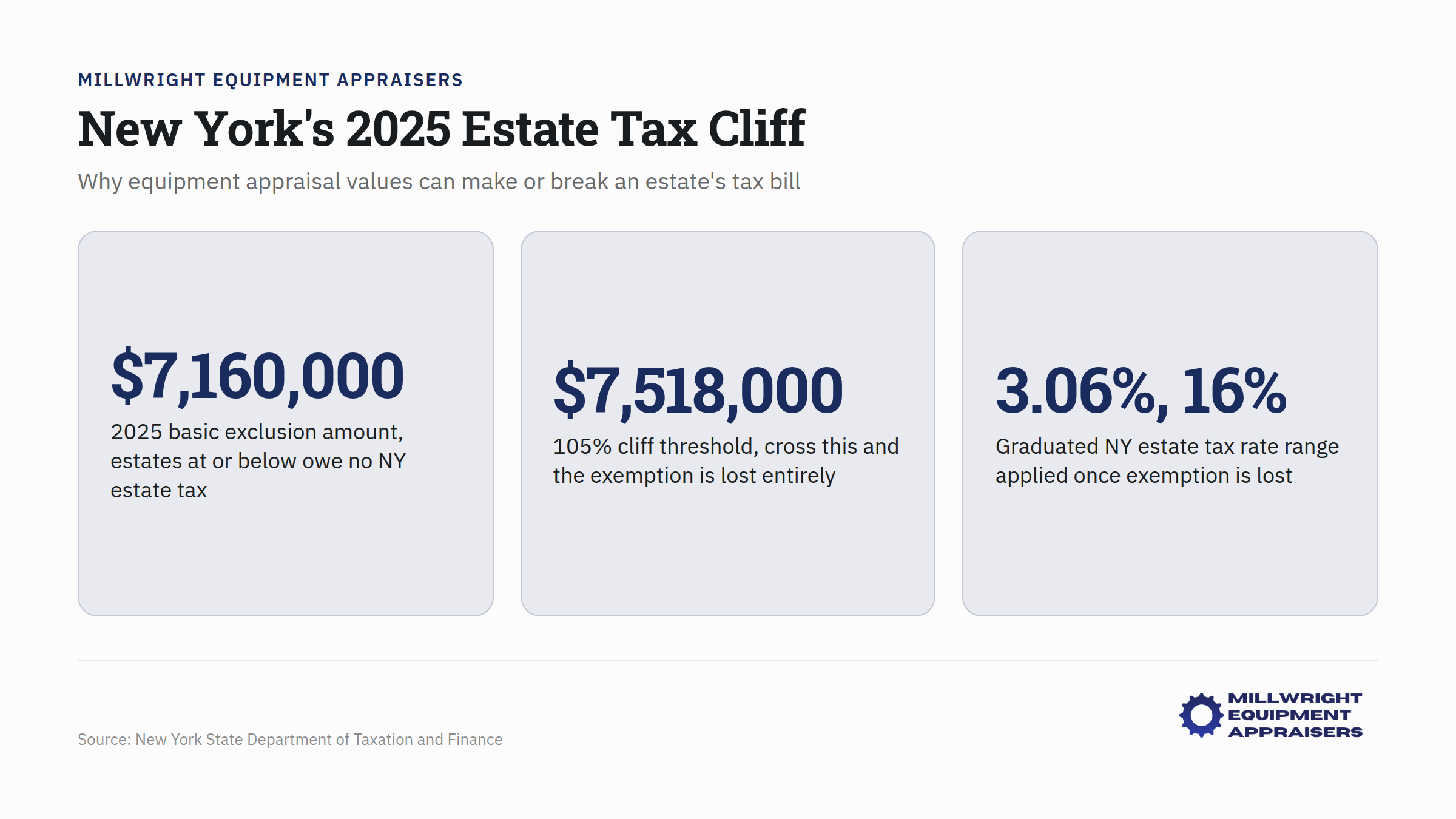
New York's 2025 basic exclusion amount is $7,160,000. An estate valued at or below that figure generally owes no New York estate tax. But New York does not phase the exemption out gradually the way the federal system does. If the taxable estate exceeds 105% of the exemption, roughly $7,518,000 in 2025, the estate loses the exclusion entirely, and New York computes tax on the full value of the estate, not just the amount above the exemption, according to the New York State Department of Taxation and Finance.
New York estate tax rates then apply on a graduated schedule ranging from 3.06% to 16%, depending on the size of the taxable estate. The cliff is what makes equipment appraisals for New York estates genuinely high-stakes: an estate sitting comfortably under the exemption with a conservative equipment value can end up on the wrong side of the cliff if that same equipment is appraised a few hundred thousand dollars higher.
Watch out: the cliff doesn't tax the marginal dollars above the exemption the way federal estate tax does. It removes the exemption altogether once the estate crosses 105% of it, so the tax bill isn't proportional to how far over the line the estate falls.
How Fair Market Value Is Defined for Business Equipment
New York does not maintain its own separate valuation standard for estate tax purposes. Form ET-706 pulls its reported asset values directly from federal Form 706, and federal estate tax valuation uses fair market value: the price a willing buyer would pay a willing seller, with neither party under compulsion to act and both having reasonable knowledge of the relevant facts, determined as of the date of death, as described in the IRS Form 706 instructions. This is a used-equipment, in-place, arm's-length standard. It is not replacement cost new, not the depreciated value carried on the business's books, and not a forced-liquidation price.
That distinction matters because business owners and their accountants often have depreciation schedules or insurance replacement values sitting in a file somewhere, and it's tempting to reach for those numbers instead of commissioning a proper appraisal. Depreciated book value almost always understates what a piece of equipment would actually sell for on the open market. Replacement cost new almost always overstates it. Both can push an estate to the wrong side of the exemption or the cliff for the wrong reasons.
Pro tip: if the business also carries insurance on the equipment, don't assume the insured value and the estate tax fair market value are the same number. They answer different questions and are calculated differently.
Date of Death vs. Alternate Valuation for Equipment
The default valuation date for New York estate tax purposes is the date of death, mirroring the federal rule under New York Tax Law § 999-A, which incorporates the federal alternate valuation framework found in IRC § 2032. An estate can elect to value assets six months after death instead, if that election reduces both the value of the gross estate and the combined estate and generation-skipping tax owed.
For equipment, this timing choice can matter. Machinery that depreciates quickly, becomes technologically obsolete, or loses value in a soft used-equipment market may be worth meaningfully less six months after death than it was on the date of death itself. If the estate sells the equipment within that six-month window, it's valued at the actual sale price on the date of disposition rather than an estimate. If it's still on hand at the six-month mark, it's revalued as of that date. Either way, the appraiser needs to know which valuation date applies before finalizing a report, since equipment values assigned under the wrong date can be rejected on review.
A Worked Example: Equipment Appraisal Near the Cliff
Consider a New York manufacturing business owner whose estate, apart from equipment, totals $6,000,000 in real estate, investment accounts, and other property. The business itself owns CNC machines, forklifts, and packaging equipment that make up the remaining major asset.
Example: If that equipment is appraised at $1,000,000 in fair market value, the total taxable estate comes to $7,000,000, comfortably under the $7,160,000 exemption, and the estate owes no New York estate tax. If the appraisal instead comes in at $1,200,000 (perhaps because someone used replacement cost figures rather than used-market fair market value), the estate rises to $7,200,000, which is over the exemption but still under the 105% cliff of $7,518,000, so tax applies only to the roughly $40,000 excess at the lowest 3.06% bracket. But if the equipment is valued at $1,550,000, the estate reaches $7,550,000, crossing the cliff. At that point New York does not tax just the amount above the exemption; it computes tax on the full $7,550,000, and the bill jumps from a few thousand dollars to a figure well into six figures.
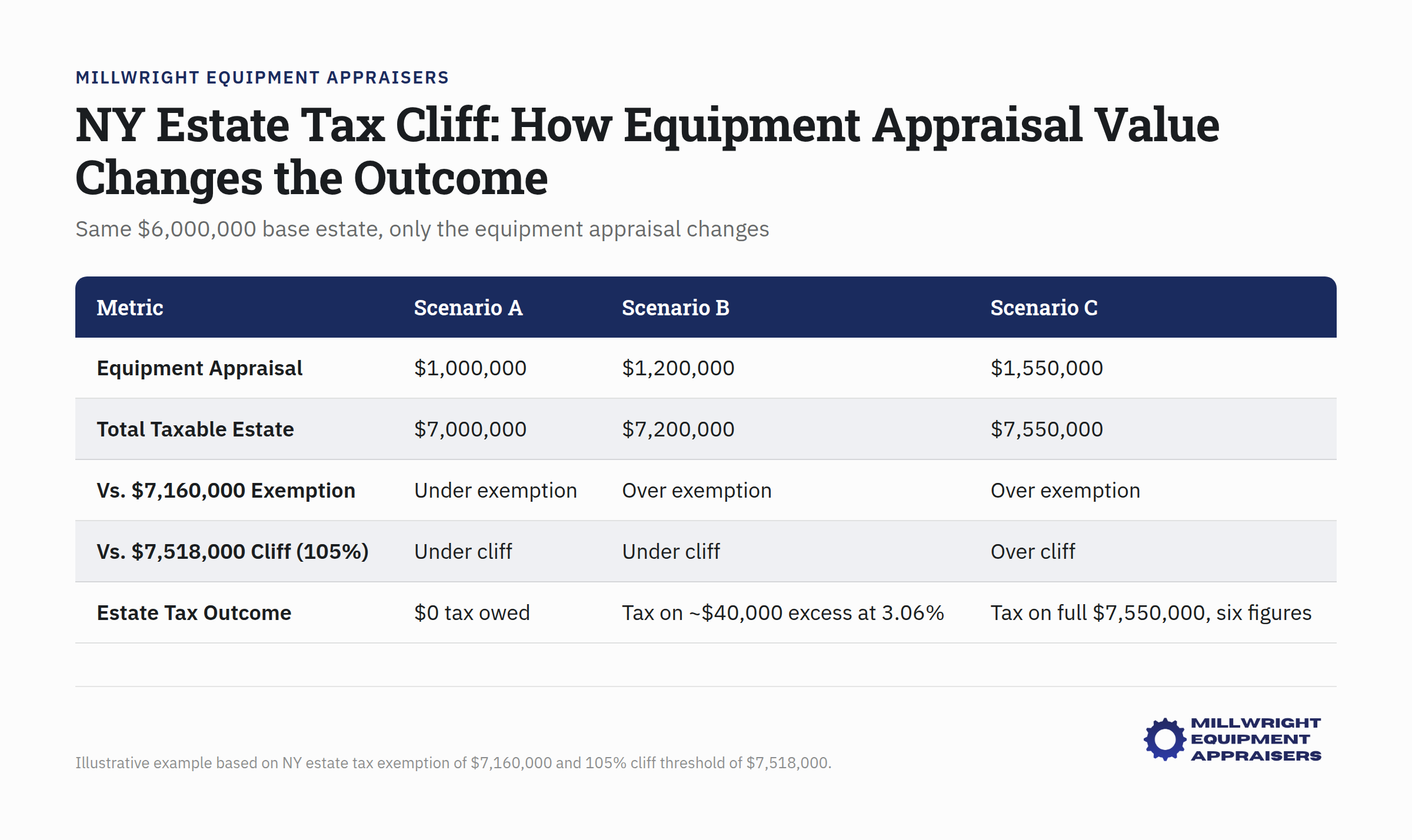
The swing between those scenarios comes entirely from a $550,000 difference in how the equipment was appraised, on an estate where the rest of the numbers never changed. That's the real-world consequence of the cliff for a business owner whose net worth sits in this range.
Key takeaway: for estates within roughly $500,000 of the 105% cliff threshold, the equipment appraisal is not a formality. It is frequently the single number that decides whether the estate pays nothing or pays tax on its entire value.
Closely Held Businesses and Installment Payment Relief
Estates where a large part of the value consists of an interest in a closely held business may qualify to pay New York estate tax in installments rather than as a lump sum, under provisions referenced in the instructions to Form ET-706. Equipment value plays directly into whether an estate meets that threshold, since machinery and production assets are often the bulk of what a small manufacturing or service business is worth. An appraisal that understates the equipment could cause an estate to miss qualifying for installment relief; one that overstates it could inflate the tax base the installment payments are calculated against. Either error affects real cash flow for the surviving family or business partners.
Why a Defensible Equipment Appraisal Protects the Estate
An appraisal prepared in accordance with USPAP (the Uniform Standards of Professional Appraisal Practice) by a credentialed appraiser gives an estate a number that can withstand scrutiny in both directions. Credentials commonly held by equipment appraisers include the ASA, CAGA, and NEBB (Certified Machinery and Equipment Appraiser), and a report built around documented market data, condition, and remaining useful life stands up better to review than a number pulled from a depreciation schedule or a rough guess.
The stakes cut both ways. An appraisal that comes in too low invites scrutiny for underreporting and potential penalties if the IRS or the New York Department of Taxation and Finance later challenges the value. An appraisal that comes in too high, often from using replacement cost instead of fair market value, can push a mid-size estate over the exemption or the cliff entirely, creating a tax liability that shouldn't exist. If you're unsure how used equipment should be valued for a fair market value standard, our guide on how the value of used equipment is determined walks through the factors an appraiser weighs.
Engagements for estate equipment appraisals are quoted as a fixed fee after the assignment is scoped, based on the number of assets, the completeness of the business's records, and the depth of analysis the estate's attorney or CPA requires. They are never billed by the hour.
Get an Equipment Appraisal Before You File
If a New York estate includes business machinery or equipment anywhere near these thresholds, get the appraisal done before the estate tax return is prepared, not after a value is challenged. A dated, documented, fair market value appraisal gives the estate's attorney and accountant a defensible number to build the filing around. Request an equipment appraisal to get started, and for more guidance on valuing machinery across estate, tax, and legal situations, browse our machinery and equipment appraisal guides.
This article is provided for general informational purposes only and does not constitute legal, tax, or financial advice. Readers should consult a qualified attorney or CPA regarding their specific circumstances.